
Tom Thumb
The first book I ever bought on my own

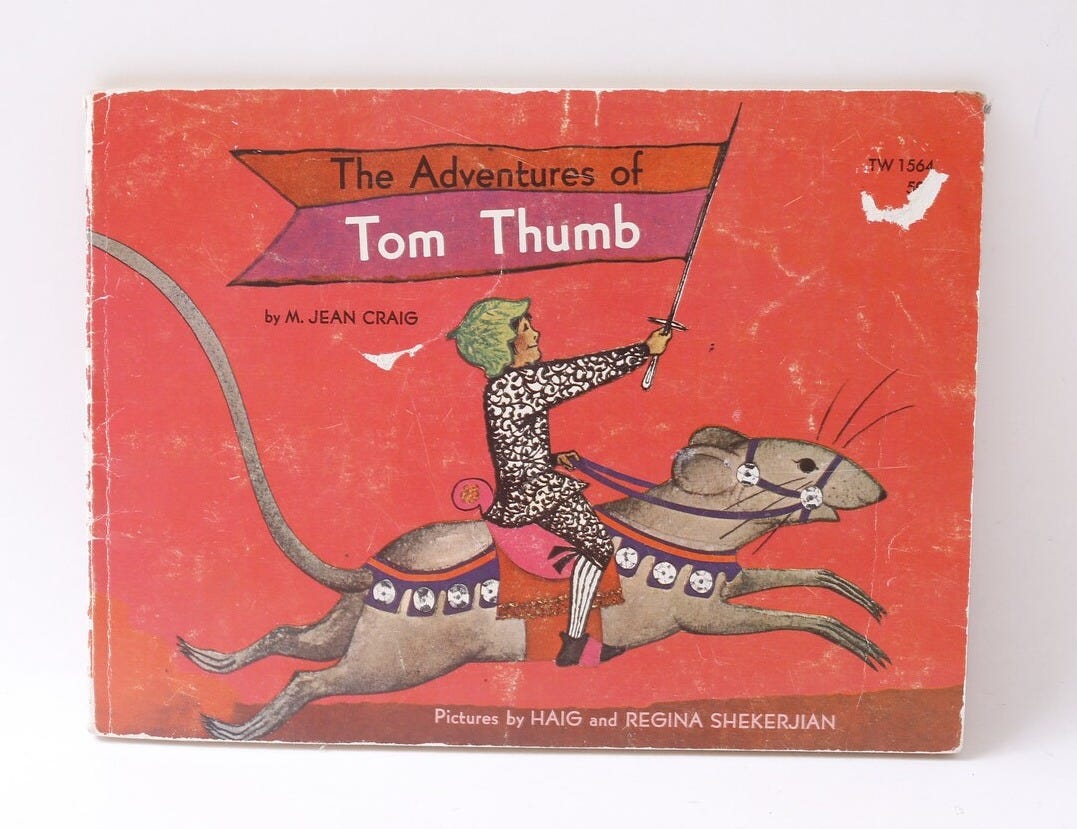
I’ve seen a lot of “advice” from Twixxer and some Stacks along the lines of “while writing, don’t think about the business side of it. Don’t worry about publication. Just write the story you want to write.” And so on.
Bullshit.
Let me tell you about the first book I chose to buy with real cash on my own. It was the first grade book fair. We’d already been to the library enough for me to know how awesome it was to check out books for a week. But now the librarian was telling us there would be books on sale for us next time. So my mom gave me money, I went to school, and I was shocked by all these books I had the choice of buying.
I know I bought more than one, but I absolutely cannot forget seeing this red cover with a little guy riding a mouse. I picked it up, flipped through, and saw more paintings of the little guy next to ordinary things, but they were all much bigger than he was!
I’ve included the cover. I wasn’t sure I’d be able to find it again, but it popped up almost immediately. And here’s the thing: if that book hadn’t had that cover, would I have picked it up? I don’t know that I would. The red was mesmerizing, and the art was really cool. I even liked the modern simple font (however a six-year-old would say that in 1979). Whoever put this book together had a real eye for what worked. I wanted this. I wanted to take this book home and read it and enjoy the art and read it again. So I did.
It wasn’t until second grade that I discovered the Hardy Boys and The Three Investigators, both huge inspirations in my writing life, but I have to say the The Adventures of Tom Thumb - that particular edition of it - made me want a book, and it made me want to make books.
Naive kid that I was, I thought making a book meant I got to do everything - write it, draw it, color it, make the cover, etc. To me, that meant folding some paper in half, starting at the beginning, and eventually having a cool book about, oh, going fishing with my grandparents, or some trick or treat mystery, or detectives looking for something stolen.
I’m trying to say that when I first started writing, it wasn’t just to tell myself a story. It wasn’t just to feel like I expressed myself. Not at all. I wanted to make a book other people would want to buy and read as much as I wanted to buy and read Tom Thumb. The very idea of making a book - a piece of art with a good story in it - was the inspiration. Storytelling, but stylized. And you bet your ass I wanted to show it to anyone who might be interested.
It’s never gone away, that love of the book as a work of art. Even in the digital era, buying Kindle books, I care what the cover looks like. But when it comes to print, I want the cover to be super stylish, I want it to feel nice (I’m not big on those high gloss cheap covers), I want the text inside to look good on the page, I want the artistic theme to carry through, and I want what’s in there to be equal or better than the package makes it out to be. You’ve hooked me. Bring it on.
When I found out much, much later that in real adult publishing that real artists and writers didn’t have as much say in the package, and that people who designed covers usually used stock imagery these days, mostly trying to copy what worked on other books in the same genre, I felt sad. I mean, I grew up seeing the hand painted covers of my grandpa’s pulp westerns and private eye novels. Those were gorgeous! But snag yourself a deal in NYC these days, I doubt you’d get that sort of individualized treatment. Plenty of sites online show how similar book covers are anymore.
I mean, Chip Kidd’s too-cool rebranding of Elmore Leonard? I wanted those editions. Same for when Vintage Crime took over Black Lizard. Or when someone at Simon & Schuster realized James Lee Burke needed a gorgeous “great American novelist” makeover instead of just focusing on the crime fiction - beautiful paintings in place of typical shadowy stock.
I’ve been lucky. As a writer on small presses I’ve had a pretty decent say in covers for my early books, and later once I shifted over to digital/self-publishing for a while. I worked with the incredible J.T. Lindroos for many titles, and he got it dead-on with only one or two tries (Check out his cover for Worm, the first appearance of Slow Bear). At Fahrenheit, The Boss has helped created a brand for my books there. Yes, stock imagery was used, but you wouldn’t know it necessarily. The stock stuff was placed in an overall gorgeous context that set these things apart from so much else on the shelves. Those things pop.
Full circle, I’m saying that many, many writers probably got their starts inspired in this way - the total package. The book as art. The book as a product other people can buy and read.
And money? Hey, I think it’s very rare for a writer to get back all of the time and effort put into a novel multiplied hundreds or thousands of times and converted into money, but we do want to feel like it was worth it on some level. We want to know that someone out there likes what we do enough to actually spend money, some of which goes into our pockets, every time the next book comes out. If dreaming about a nice advance helps, then do it. Scrooge McDuck-level advance!
So writers, while you’re working on that novel, either your debut you hope gets picked up by an agent and Big 4, or your tenth novel on a small press, or the next entry in your self-published series, it’s okay to dream about the finish line. It’s okay to think about how publishers might try to outbid each other for it. It’s fine to imagine the thrill of seeing a cover that matches the feeling you have about your book. This is all perfectly fine, and in many ways it provides extra motivation and excitement.
All of the writers in our English Department at work have their books displayed in a glass cabinet out in our hallway, and even after twenty years here, I can’t help but grin every time a new title is added to the line-up of my stuff. Look at those things. Nice!
It all started with Tom Thumb at an elementary book fair on the Mississippi Gulf Coast in 1979.
Wow! JT did all my covers when I got my rights back and republished everything. I adore those covers! I think he's too famous now for me to afford. Anyway, your Slow Bear covers are certainly up there with the best!
I chatted with a picture book author this week. She published with Farrar Strauss Giroixoixxio and had a choice of illustrators to work with. I was impressed. She was shocked she had the option.
She ended up with an artist from Buenos Ares who considered the Midwest setting exotic. Which I think makes perfect sense.